In the YouTube tools ecosystem vidIQ is the veteran. Founded in 2011 it claims over 20 million creators and remains the historical reference alongside TubeBuddy. But between its heavy pivot toward AI and a credit system now gating almost every feature, does it still deliver in 2026? In this complete vidIQ review we examine its features, its pricing and its real limitations.
vidIQ is first and foremost a YouTube growth platform built around keyword research, channel analytics and a browser extension that overlays its data directly on YouTube. Since 2023 the platform pivoted hard into AI, adding an AI Coach, title and description generators, a thumbnail maker and more recently an MCP server connecting its data to Claude or ChatGPT.
On pricing the structure has become more complex than it used to be. A free plan gives 150 monthly AI credits and the extension's core stats. The Boost plan runs around $39 per month or $199 per year, roughly $18 monthly on annual billing, with 2,000 credits. The Max plan costs about $34 monthly but on annual billing only, around $405 per year, with 6,000 credits.
It is precisely this credit system that deserves attention. Every title generation, thumbnail or AI Coach conversation draws from a shared monthly pool that does not roll over and that no top-up can replenish. Users regularly report hitting their ceiling before month-end, with the thumbnail generator being particularly hungry.
That is also the tool's structural limit on thumbnails: a generator bolted onto a research suite is not built around click-through rate.
This is where Pikzels available at pikzels.com operates differently, with Persona, Style and the Pikzels Score measuring virality, clarity, idea, curiosity and emotion. With over 5.1 million videos packaged and 7.1 billion views generated it is trusted by creators worldwide.
In this article we reveal our complete vidIQ review for 2026.
What Is vidIQ?
Say Goodbye to 10 of 10s Say Goodbye to 10 of 10s Try Pikzels for Free.
Shortcut your way to millions of views.
vidIQ available at vidiq.com is an optimization and growth platform dedicated to YouTube. Founded in 2011 it ranks among the oldest tools in the space alongside TubeBuddy and claims over 20 million creators today. Its original promise was simple: help you identify what your audience searches for, then optimize your videos to rank for those queries.
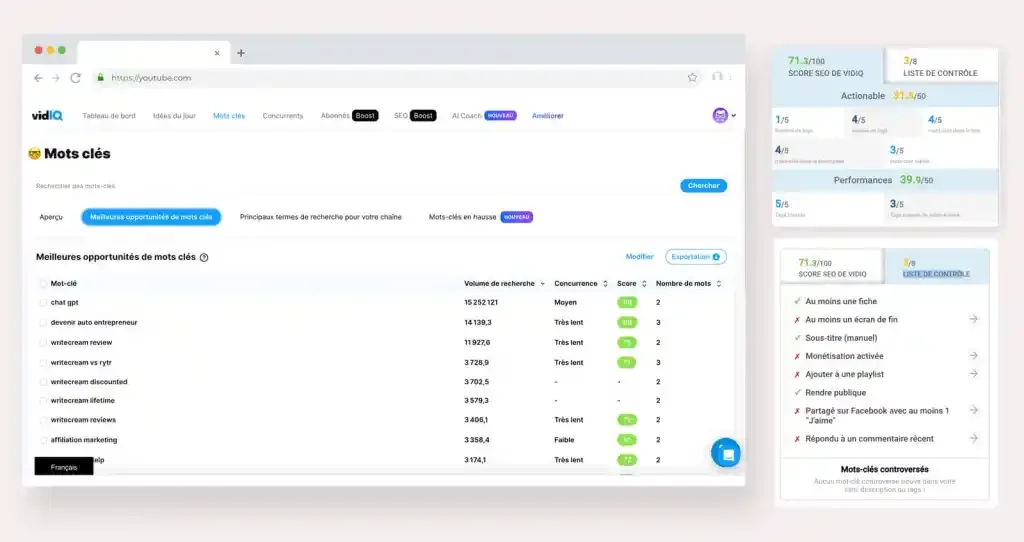
The core of the product remains keyword research. You enter a topic and vidIQ returns search volumes, competition levels and a score indicating your chances of ranking. This approach made complete sense when YouTube search drove a meaningful share of views, even though discovery today happens largely through recommendations.
Its second pillar is the browser extension which overlays data directly on YouTube while you browse. You see a video's stats, its tags, its SEO score and comparative channel performance without switching tabs. This is historically what drove the tool's adoption.
Since 2023 the platform has made a heavy pivot toward AI. It added a conversational AI Coach, generators for titles, descriptions and thumbnails, plus a credit system now powering almost all of these features. More recently an MCP server connects its data to Claude, ChatGPT or Cursor.
vidIQ therefore targets creators looking to optimize their YouTube SEO and analyze competitors. Its scope covers research and analysis rather than creation.
For thumbnails specifically Pikzels available at pikzels.com is built around that single objective.
What Are the Main Features of vidIQ?
The platform covers a wide scope ranging from keyword research to AI-assisted generation. Here are the main features of vidIQ.
Keyword research
This is the historical feature and the one that built the tool's reputation. You enter a topic and vidIQ returns search volumes, competition level and an opportunity score indicating your realistic chances of ranking. The tool also suggests related keywords and long-tail queries. This is probably where vidIQ remains strongest against its competitors.
Browser extension
The Chrome extension overlays vidIQ's data directly on YouTube while you browse. You check a video's stats, its tags, its SEO score, its velocity and comparative channel performance without ever leaving the platform. For a creator regularly analyzing competitors this fluidity is genuine and largely explains the tool's mass adoption.
AI Coach
Added during the 2023 AI pivot the AI Coach functions as a conversational assistant specialized in YouTube. You ask it questions about your strategy, your video ideas or your performance and it responds drawing on your channel data. Every conversation consumes credits which limits heavy use on entry-level plans.
Daily Ideas and trend research
vidIQ provides daily video idea suggestions based on your niche and observed trends. Its trend research tool also identifies rising topics before they saturate. This is useful for feeding an editorial calendar without starting from a blank page every week.
Title and description generators
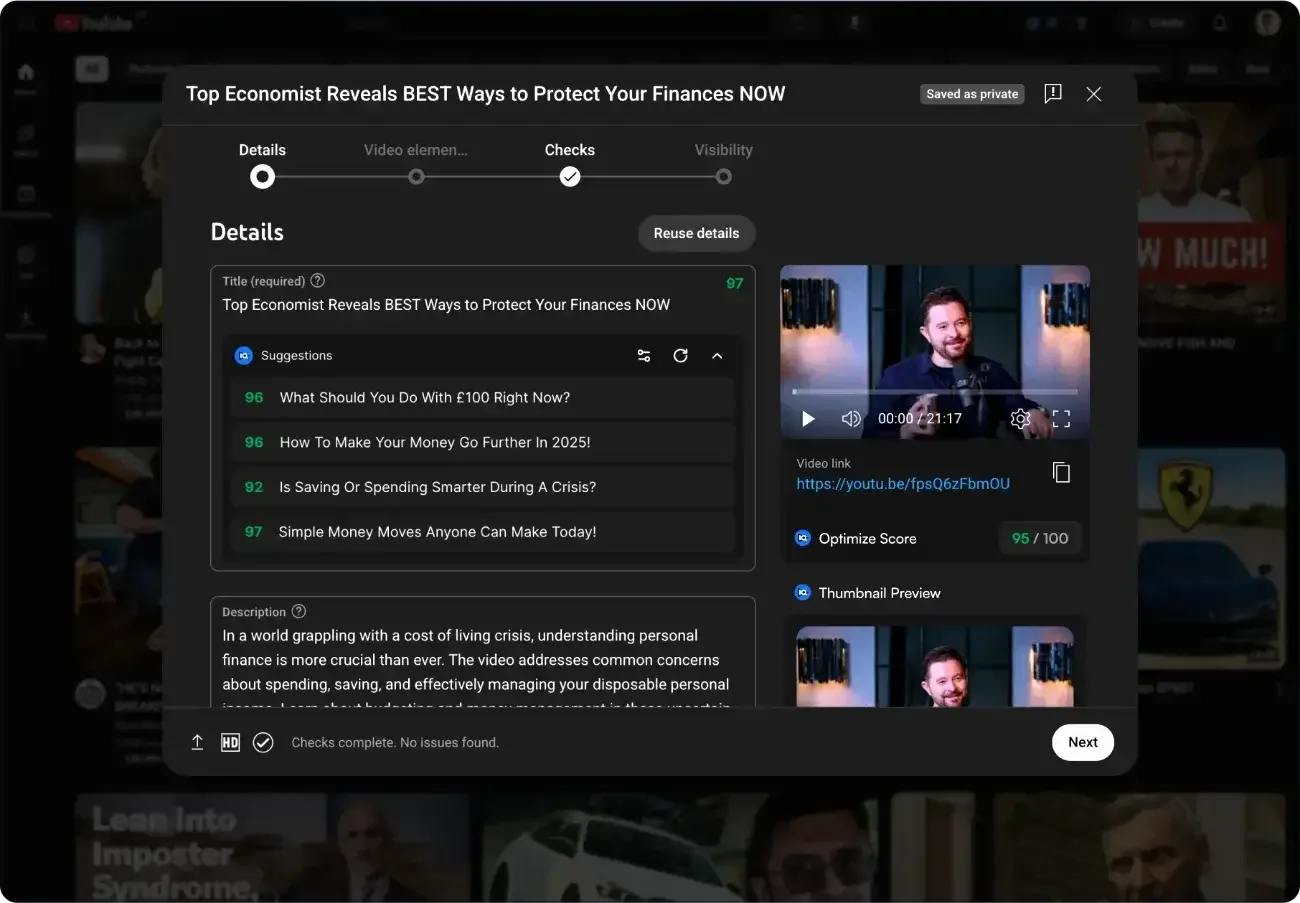
The platform generates optimized titles, descriptions and tags from your topic. These features also consume credits. Note that vidIQ offers lightweight free versions of these generators on its site without any subscription.
AI thumbnail generator
vidIQ includes a thumbnail generator within its suite. Its theoretical advantage is access to your channel data and therefore your past performance. Two significant limitations apply however. It is particularly credit hungry, to the point that users frequently report exhausting their monthly quota before month-end. And it remains one feature among dozens rather than a product built around click-through rate.
Channel and competitor analytics
The tool provides analytics dashboards covering your views, your audience, your traffic sources and subscriber evolution. You can also track competitor channels and compare their performance to yours. Part of this data already exists free in YouTube Studio however.
MCP server
A recent addition, the MCP server connects vidIQ's data to AI assistants like Claude, ChatGPT or Cursor. You then query your data conversationally. Each call consumes roughly five credits from the same shared pool, which makes regular use expensive in practice.
The credit system
This is not a feature but a mechanism gating all the others. Every AI action draws from a shared monthly pool that resets without rolling over and that no top-up can replenish. Once exhausted the AI tools pause until the next cycle.
For thumbnails Pikzels available at pikzels.com avoids this constraint with an allocation built for regular use.
What Does vidIQ Cost?
vidIQ offers three plans including a free tier, with displayed prices corresponding to annual billing. Here is what vidIQ costs.
Table: vidIQ pricing plans
Feature
Free
Boost
Max
Monthly price (annual billing)
$0
Around $18
Around $34
Total annual cost
$0
Around $216
Around $405
Annual saving
None
$32
$105
Monthly AI credits
150
2,000
6,000
Niche trends
Included
Included
Included
Content ideas
Data-backed
Personalized
Personalized
AI Coach
Personalized tips
Deep thinking
Up to 3x more conversations
Thumbnail generator
Not included
Included
Included
Trend research
Limited
Unlimited
Unlimited
Subscriber insights
Not included
Unlimited
Unlimited
Max Mode AI
Not included
Not included
5x more powerful
Short clip generation
Not included
Not included
Up to 11 hours
Masterclasses
Not included
Included
Included
As the table shows the free plan genuinely lets you test the tool with 150 monthly credits, niche trends and the AI Coach. That quota depletes quickly however once you start generating titles or thumbnails.
The Boost plan at around $18 on annual billing is what most users actually pay for. It unlocks the thumbnail generator, unlimited trend research and 2,000 credits. Note that monthly billing costs considerably more.
The Max plan at around $34 triples your credits and adds Max Mode AI plus short clip generation.
The point of caution remains the credit system since every AI feature draws from the same pool with no rollover and no top-up available.
What Are the Limitations of vidIQ?
The tool remains solid on its core competency but several constraints deserve attention before subscribing. Here are the main limitations of vidIQ.
A restrictive credit system where every AI feature draws from a shared pool that does not roll over and that no top-up can replenish
A credit-hungry thumbnail generator to the point that users frequently report exhausting their quota before month-end
No built-in thumbnail A/B testing unlike certain competitors, despite this being precisely what improves click-through rate
Per-channel subscriptions which makes multi-channel management expensive quickly and pushes you toward enterprise pricing
Monthly billing considerably more expensive than annual, with the gap approaching double on the Boost plan
No prorated refunds if you cancel an annual subscription mid-period
Data partially available for free since YouTube Studio already provides your analytics, traffic sources and click-through rate
An approach still centered on SEO while YouTube discovery now happens largely through recommendations rather than search
Title and tag generators available free elsewhere, including on vidIQ's own site through its open-access tools
Among these the credit system is by far the most structural. It turns every action into a trade-off since generating a thumbnail means forgoing several AI Coach conversations. This discourages precisely what grows a channel: testing multiple variants.
The absence of A/B testing is the second notable gap for a tool positioning itself as a growth platform.
For thumbnails specifically Pikzels available at pikzels.com lets you generate several contrasting variants with no trade-off.
vidIQ vs Pikzels: Which Tool for Which Need?
These two platforms are often compared but they answer different questions. vidIQ tells you what to make. Pikzels lets you package it so people click. Here is the comparison.
Table: vidIQ vs Pikzels
Criterion
vidIQ
Pikzels
Core purpose
YouTube SEO research and analytics
Thumbnails built for click-through rate
Thumbnail generation
One feature among dozens
The entire product
Credit system
Shared pool, no rollover
Allocation built for regular use
Face consistency
Not available
Persona from 3 photos
Visual identity
Not available
Style learned from your thumbnails
Proven format recreation
Not available
Rebuild from a YouTube link
Packaging evaluation
Not available
Pikzels Score on 5 criteria
Automatic correction
Not available
One-Click Fix
Variant testing
Expensive in credits
No trade-off
Keyword research
Very comprehensive
Not applicable
Channel analytics
Complete
Not applicable
Trusted by
Over 20 million creators
Creators worldwide
As the table shows the two tools are complementary across most dimensions. vidIQ excels at keyword research, competitor analysis and trends. Pikzels makes no attempt to replicate these capabilities.
On thumbnails however the gap is clear. vidIQ generates an image while consuming a significant share of your monthly quota, without telling you whether it will perform. Pikzels generates a thumbnail built to be clicked, preserves your face through Persona, enforces your identity through Style and scores your packaging across virality, clarity, idea, curiosity and emotion.
The most concrete difference remains variant testing. With vidIQ each additional generation depletes your credits, which discourages exactly the experimentation that grows a channel.
Use vidIQ for your research and Pikzels for your thumbnails available at pikzels.com.
vidIQ Review: Is vidIQ Worth It in 2026?
To conclude this vidIQ review the tool remains solid on its core competency. If your need centers on keyword research, competitor analysis and trend identification, it delivers. Its browser extension overlaying data directly on YouTube remains among the most practical on the market, and its longevity since 2011 gives it a database and a reliability few competitors match.
Its free plan is also more generous than it appears since it provides core stats, niche trends and the AI Coach with 150 monthly credits. That is enough to evaluate the tool seriously before paying. The Boost plan at around $18 on annual billing remains reasonable for a creator publishing regularly.
Its limitations are equally clear. The credit system now gates every AI feature and turns your usage into a constant trade-off. Generating a thumbnail means forgoing several AI Coach conversations, and users frequently report exhausting their quota before month-end. No top-up is available and credits do not roll over. Subscriptions also work per channel, which becomes expensive as soon as you manage several.
But the underlying point goes beyond these details. vidIQ tells you what to make, not how to package it. Its thumbnail generator is one feature among dozens inside a research suite rather than a product built around click-through rate. It does not tell you whether your thumbnail will perform, does not preserve your visual identity and discourages testing multiple variants since every generation costs credits.
This is where Pikzels available at pikzels.com operates on another level. Persona places your face on every video, Style applies your visual identity, Recreate rebuilds validated formats from a YouTube link and the Pikzels Score evaluates virality, clarity, idea, curiosity and emotion before publication, with One-Click Fix correcting the weak points. With over 5.1 million videos packaged and 7.1 billion views generated it is trusted by creators worldwide.
So is vidIQ worth it in 2026? For research and analysis, yes. For your thumbnails, pair it with Pikzels.