Your thumbnail decides whether a video gets watched or scrolled past. Yet most creators still spend thirty minutes in a tool that knows nothing about YouTube, then publish and hope. So which thumbnail makers actually deserve your time in 2026?
The market has shifted. Two years ago the question was Photoshop or Canva. Today AI has removed the production barrier entirely, which means speed is no longer the differentiator since almost everything is fast.
What separates tools now is whether they understand the real problem. That problem is not producing an attractive image. It is producing one that earns a click, on a phone screen, among dozens of competitors.
Four criteria therefore guide this ranking: native 1280 x 720 format, face consistency across videos, visual identity that belongs to you rather than a shared template library, and packaging evaluation telling you whether your design will perform before publication.
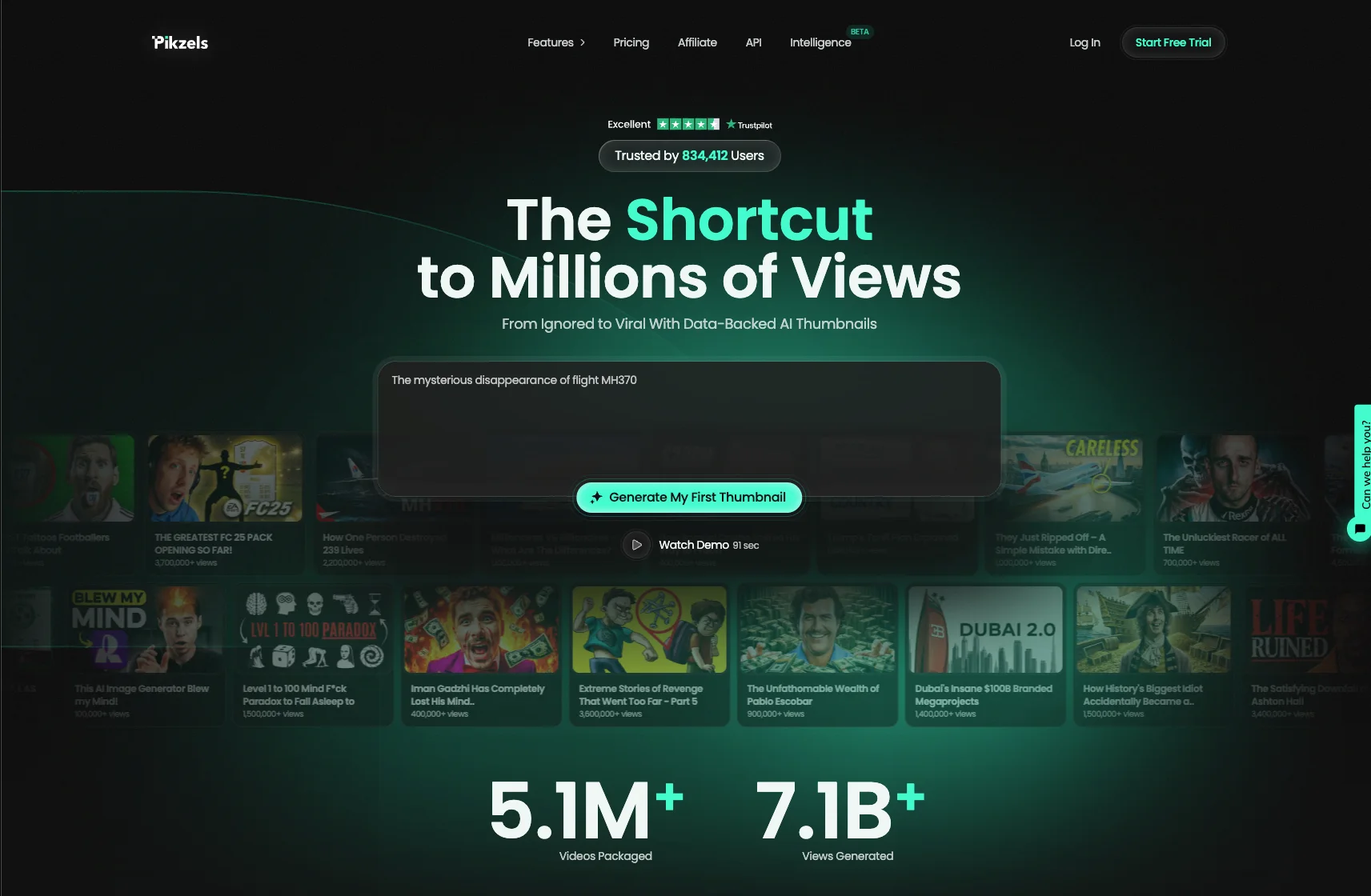
Leading our ranking Pikzels available at pikzels.com is the only tool built entirely around click-through rate, with Persona, Style, Recreate and the Pikzels Score measuring virality, clarity, idea, curiosity and emotion.
With over 5.1 million videos uploaded and 7.1 billion views generated, our service is trusted by creators worldwide.
In this article we reveal the top 10 best thumbnail makers in 2026.
1. Pikzels
Pikzels tops this ranking as the only tool built entirely around a single question: will this thumbnail be clicked? Available at pikzels.com, it is neither a design application adapted to YouTube nor an image generator applied to thumbnails. It was engineered for click-through rate from the start.
Say Goodbye to 10 of 10s Say Goodbye to 10 of 10s Try Pikzels for Free.
Shortcut your way to millions of views.
The first decisive feature is Persona. You upload three photos once, and your face is placed consistently across every thumbnail you generate afterwards. No cutting out a new image each time, no drift in lighting or angle between videos. That consistency matters because viewers identify a channel visually before reading a single word.
The second is Style. Rather than handing you a template thousands of other creators share, Pikzels learns your visual identity from your existing thumbnails and applies it forward. Your colors, your typographic treatment, your framing. You build recognition instead of borrowing someone else's look.
The third is Recreate. You paste any YouTube link and the tool rebuilds that proven format with your own idea and your own visual. This gives you access to compositions already validated by the market without copying protected material.
The fourth and most distinctive is the Pikzels Score. Every thumbnail is evaluated across five criteria: virality, clarity, idea, curiosity and emotion. You know before publishing whether your packaging holds up, and One-Click Fix corrects whatever falls short.
That last capability is what no other tool in this ranking offers. Every alternative hands you a file and stops there. Pikzels tells you whether that file stands a chance.
Practical details complete the picture. Generation takes seconds rather than the fifteen to thirty minutes a design tool requires. Output arrives in the native 1280 x 720 format with no configuration. And producing several variants costs no extra effort, which finally makes YouTube's Test and Compare feature usable rather than theoretical.
With over 5.1 million videos uploaded and 7.1 billion views generated, our service is trusted by creators worldwide.
Start at pikzels.com.
2. Canva
Canva ranks second as the most widely used design tool among creators, and its reputation is deserved. For anyone making their first thumbnails without a design background, it removes barriers that would otherwise stop them entirely.
Its first strength is the YouTube preset at 1280 x 720. You never have to research dimensions or discover after upload that YouTube cropped your subject, and export settings handle the 2 MB limit without you thinking about compression.
Its second strength is genuine accessibility. The drag-and-drop editor requires no learning curve, no layers panel to understand and no tutorial to watch first. Compare that to Photoshop, where producing a basic thumbnail means learning selections and masks before creating anything usable.
Its third strength is the template library. Rather than facing a blank canvas, you start from a structure that teaches you what a functional layout looks like: where text sits, how large a subject should be, how elements relate.
Its fourth is the background remover, which handles the most tedious part of thumbnail creation in one click with quality perfectly adequate at thumbnail size.
Its free plan covers the preset, a substantial portion of templates and unlimited exports, genuinely removing the cost barrier for creators starting out.
The limitations appear precisely where thumbnails are won. Canva is a general design tool with no concept of click-through rate. It cannot tell you whether your text is readable at small size, whether your contrast stands out in a feed or whether your composition creates curiosity.
Its templates compound this. Shared by millions of creators, they hand you a layout thousands of other channels already use, which works directly against the recognition that drives clicks.
Consistency requires manual repetition as well. Keeping your face and visual identity stable across videos means duplicating files and rebuilding by hand every time.
Finally the time cost is real: fifteen to thirty minutes per thumbnail, which becomes ninety minutes weekly at three videos.
Canva remains excellent for general design work. For thumbnails specifically, Pikzels at pikzels.com is purpose-built.
3. Adobe Express
Adobe Express ranks third as the most credible alternative to Canva, backed by a company whose expertise in creative software needs no introduction. It sits between a simplified editor and the professional suite Adobe built its reputation on.
Its first strength is Adobe Firefly integration. The generative AI model handles text-to-image creation, generative fill and object removal directly within the editor, with outputs trained on licensed content rather than scraped material. For creators concerned about commercial rights, that distinction carries genuine weight.
Its second strength is output quality. Adobe's rendering engine, color handling and typography control reflect decades of accumulated expertise. Thumbnails produced in Express frequently look more polished than equivalents made in lighter tools, particularly on gradients, shadows and text treatment.
Its third strength is the Creative Cloud ecosystem. If you already use Photoshop, Premiere Pro or Lightroom, assets sync across applications and your brand kit follows automatically. A creator editing video in Premiere can move a frame into Express without leaving the ecosystem.
Its fourth is the brand kit, letting you save colors, fonts and logos for consistent application. This is closer to real identity management than template selection, though it still requires manual application on every design.
A free plan covers the basics with Firefly generations limited by a monthly credit allowance.
The limitations mirror Canva's with one addition. Adobe Express remains a general design tool that knows nothing about click-through rate, readability at thumbnail size or the visual codes performing in your niche. It produces a polished image without indicating whether it will earn a click.
Its learning curve is steeper than Canva's. The interface carries more options and more depth, which suits users comfortable with creative software and slows those who are not.
Firefly credits also impose a ceiling, meaning heavy generation exhausts the monthly allowance and forces arbitrage between testing and economizing.
Adobe Express suits creators already inside the Adobe ecosystem. For thumbnails built for clicks, Pikzels at pikzels.com is dedicated to that purpose.
4. Photoshop
Photoshop ranks fourth as the reference tool for anyone wanting complete control over their thumbnails. It remains the standard among professional designers, and most of the thumbnails you admire on large channels were almost certainly made in it.
Its first strength is total creative freedom. Nothing constrains what you can produce. Layer masks, blending modes, advanced selections, precise color grading, custom brushes and non-destructive adjustments give you control no simplified editor approaches.
Its second strength is cutout quality. Separating a subject from its background with clean edges, preserved hair detail and realistic lighting integration is where Photoshop genuinely separates itself. Automatic background removers handle this adequately at thumbnail size, but the difference becomes visible on complex subjects.
Its third strength is reusable workflows. Once you build a template with layers properly structured, swapping an image and adjusting text takes minutes rather than rebuilding from scratch. Actions and smart objects automate repetitive steps, which makes an experienced user considerably faster than the tool's reputation suggests.
Its fourth is generative AI integration through Firefly, bringing generative fill, expand and object removal into the same workflow.
The limitations are substantial for most creators. The learning curve is genuinely steep, requiring weeks or months to reach competence rather than hours. For a creator whose priority is publishing rather than designing, that investment rarely pays off.
Its cost is a subscription rather than a free tier, which matters for creators without revenue yet.
The time per thumbnail is the highest in this ranking, frequently thirty to sixty minutes for someone not already fluent, which makes variant testing practically impossible.
Most importantly, Photoshop is a general image editor with zero knowledge of YouTube. No preset guarantees the format, nothing enforces consistency across videos, and nothing indicates whether your thumbnail will perform.
Photoshop suits creators with design skills who want maximum control. For speed, consistency and performance feedback, Pikzels at pikzels.com is built for exactly that.
5. Figma
Figma ranks fifth as the most unexpected entry in this list, since it was built for interface design rather than for thumbnails. Yet a growing number of creators use it precisely because its underlying logic suits repeatable visual production remarkably well.
Its first strength is components and variants. You build a thumbnail structure once, define which elements change and which stay fixed, then produce new thumbnails by swapping only the variable parts. For a channel publishing regularly, this turns thumbnail production into assembly rather than creation.
Its second strength is auto layout. Text that resizes its container, elements that reposition automatically, spacing that stays consistent without manual adjustment. Where Photoshop requires you to realign everything after a change, Figma handles it structurally.
Its third strength is real-time collaboration. A creator and an editor can work on the same file simultaneously, leave comments and track version history. For teams managing several channels, this coordination genuinely beats passing files back and forth.
Its fourth is the generous free plan, which covers everything most creators need without a subscription.
The limitations matter. Figma is an interface design tool, which means it lacks photo editing capabilities entirely. No background removal, no advanced retouching, no color grading. You must prepare your images elsewhere and import them, adding a step to every thumbnail.
Its learning curve sits between Canva and Photoshop. Components, variants and auto layout are powerful once understood and genuinely confusing before that.
And like every tool in this ranking apart from the first, it knows nothing about YouTube. No native format preset, no understanding of readability at thumbnail size, no indication of whether your design will earn a click.
6. Thumbmagic
Thumbmagic ranks sixth as a dedicated AI thumbnail generator, positioned specifically on YouTube rather than adapted from a general design tool. That focus is its main argument.
Its first strength is speed. You describe what you want or upload a reference, and the tool generates in seconds rather than the fifteen to thirty minutes a manual editor requires. For a creator publishing several times weekly, that difference compounds significantly.
Its second strength is the native YouTube format. Output arrives in 1280 x 720 without configuration, which removes the cropping errors that catch beginners using generalist tools.
Its third strength is its template and style library, oriented toward formats that perform on the platform rather than toward generic design aesthetics.
Its fourth is face integration, letting you place yourself in generated thumbnails without manual cutting out.
Its pricing follows a tiered structure. Starter sits at 17 dollars monthly on annual billing against 29 month to month, Pro at 35 dollars annually against 59, and Business at 59 dollars annually against 99. The annual discount is substantial, reaching 480 dollars on the top tier.
Three limitations deserve attention. The monthly generation caps constrain iteration, which matters since testing several variants is precisely how click-through rate improves.
Style consistency across videos requires manual effort rather than being learned and applied automatically, which weakens the recognition that drives clicks from your existing audience.
And most importantly, Thumbmagic generates without evaluating. You get an image with no indication of whether it will perform, which leaves you publishing on intuition.
Thumbmagic suits creators wanting fast AI generation at a moderate price. For packaging evaluated before publication, Pikzels at pikzels.com scores virality, clarity, idea, curiosity and emotion.
7. 1of10
1of10 ranks seventh with an important clarification: it is primarily a YouTube research platform rather than a thumbnail maker. Its generation feature exists but sits well behind its core product.
Its first strength is the Outlier Finder, which identifies videos beating their own channel average by 10x to 100x. Ranking by outlier score rather than raw views surfaces formats that genuinely broke out instead of videos from channels that were already large.
Its second strength is Thumbnail Search, letting you search by what appears inside a thumbnail rather than by keyword. For understanding the visual codes of your niche, this is genuinely useful research.
Its third strength is its Chrome extension, which layers outlier scores directly over YouTube and works free without an account.
Its fourth is its free plan, covering outlier search, bookmarking and three tracked channels, which makes it a working tool rather than a demo.
Its AI Thumbnail Generator produces 2 to 12 variations from a sketch, reference image or title, with editing tools including Magic Eraser, Face Swap and 4K upscale.
Three limitations matter. The generator sits behind the 89 dollar Pro tier monthly, or 69 dollars annually, which is steep for a secondary feature.
It draws from a shared 1,000 credit monthly pool alongside title and idea generation, meaning producing five thumbnail variants directly reduces everything else you can generate. That arbitrage discourages exactly the testing that improves click-through rate.
And like every tool here apart from the first, it offers no packaging evaluation. It generates an image without telling you whether it will perform.
8. Nano Banana
Nano Banana ranks eighth and is the nickname given to Google Gemini's image models. It is a generalist AI tool rather than a thumbnail maker, which explains both its strengths and its limits here.
Its first strength is semantic editing without masks. You describe what you want changed in natural language and the model understands the relationships between objects, lighting and composition. No layers, no selections, no retouching skill required.
Its second strength is character consistency. You can modify a photo several times without the face drifting between generations, which was the main weakness of competing generators.
Its third strength is multi-image fusion, combining several sources into a coherent composition with perspective and lighting properly adjusted.
Its fourth is accessibility. The model is free through the Gemini app with roughly 100 daily edits, with paid tiers starting around 10 dollars monthly on annual billing.
Its fifth is text rendering on the Pro version, which handles legible in-image text where most generators still fail.
Three limitations matter for thumbnails specifically. Nano Banana knows nothing about the 1280 x 720 format, which you must request and verify on every generation.
It has no memory of your visual identity. Keeping your face and style consistent means redescribing everything in every prompt, since no profile is saved.
And most importantly, it offers no performance evaluation. You get a beautiful image with no indication of whether it will earn a click, which is the entire question for a thumbnail.
9. Snappa
Snappa ranks ninth as one of the simplest graphic design tools available for creators who want speed above everything else. Its entire positioning rests on removing friction rather than on offering depth.
Its first strength is immediate usability. The interface is deliberately minimal, with no layers panel, no complex menus and no learning curve. You select a format, drop in an image, add text and export. For someone who finds Canva already too dense, Snappa is noticeably lighter.
Its second strength is its preset library, which includes the YouTube thumbnail format at 1280 x 720 alongside sizes for every major social platform. Choosing the right dimensions requires no research.
Its third strength is its stock photo and graphics library, included rather than sold separately, which removes the need to source images elsewhere for creators without their own photography.
Its fourth is the background remover, handling the most tedious part of thumbnail creation in one click.
Its free plan allows a limited number of downloads monthly, with paid tiers unlocking unlimited exports and team features.
Three limitations matter. Its depth is genuinely shallow compared to Canva or Adobe Express, with fewer templates, fewer effects and fewer customization options. The simplicity that makes it accessible also caps what you can produce.
Its template library is shared by all users, which works directly against the visual differentiation that drives recognition in a crowded feed.
And like every generalist tool here, it has no concept of click-through rate. It produces an image without knowing what it will be used for, with no indication of whether it will perform.
10. Fotor
Fotor closes this ranking as a general-purpose photo editor that added design and AI features over time. Its breadth is both its main argument and its principal weakness for thumbnails specifically.
Its first strength is photo editing depth. Fotor began as a retouching tool, which means its adjustments on exposure, color, sharpening and skin smoothing go further than most design-first platforms. If your thumbnail starts from a photograph needing real correction, that matters.
Its second strength is its AI toolkit, including background removal, object removal, image upscaling and AI image generation from text prompts, all accessible without switching tools.
Its third strength is its template library covering the YouTube thumbnail format alongside social media sizes, with a preset at 1280 x 720 that removes any dimension guesswork.
Its fourth is accessibility across devices, with browser, desktop and mobile versions synchronizing your work.
Its free plan covers basic editing with watermarks on certain AI features, while paid tiers unlock the full toolkit and remove export limits.
Three limitations matter. Its identity is diffuse. Fotor tries to serve photo editing, graphic design and AI generation simultaneously, which means it excels at none of them compared to specialized alternatives.
Its AI generation quality trails dedicated models, particularly on faces, which is precisely what most YouTube thumbnails require.
And like every generalist tool in this ranking, it carries no understanding of click-through rate. It knows nothing about readability at thumbnail size, the visual codes performing in your niche, or whether your composition creates curiosity.
Fotor suits creators needing photo retouching alongside basic design work. For thumbnails evaluated on performance before publication, Pikzels at pikzels.com scores virality, clarity, idea, curiosity and emotion.